
Context
Kliniox grew out of on-site work at CLIOLAB, a dental practice and laboratory that has operated for thirty years. We studied how the team schedules appointments, cares for patients, collects payments, manages supplies, and coordinates with the lab. That workflow shaped the product’s modules.
Problem
Patient care generates information that the front desk, clinicians, and administrators all need. An appointment can lead to several visits, each visit may use materials, and the patient may pay in installments. The clinic also has a paper archive. The challenge was to connect those tasks and recover information from older records without transcribing them in full.
Solution
- Patients and records. Patient profiles with medical history, past visits, treatments, and related documents.
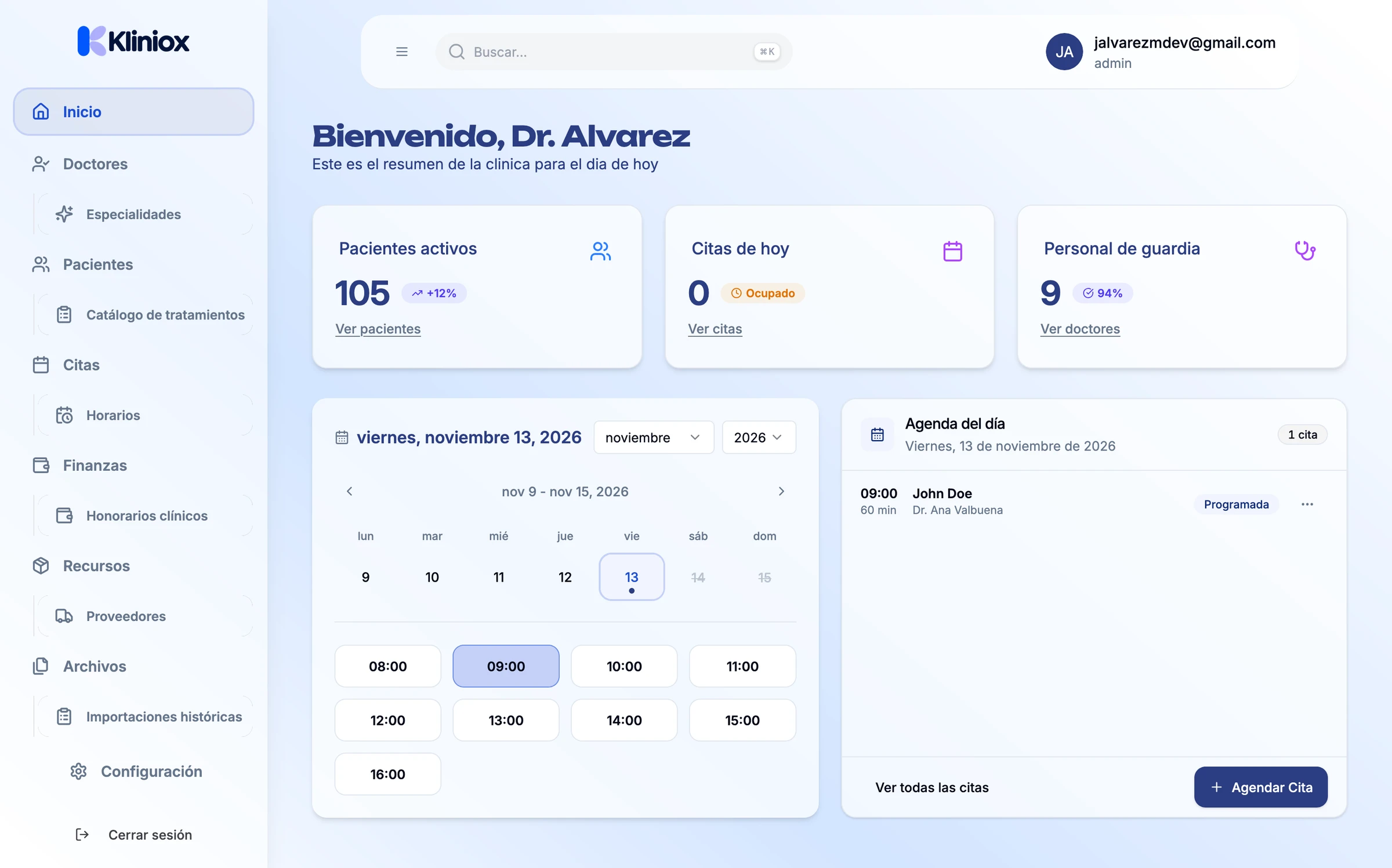
- Scheduling and staff. Appointment calendar, practice hours, professionals, and specialties, with checks for scheduling conflicts.
- Treatments and visits. Procedure catalog, visit planning, and records of clinical progress, time spent, and materials used.
- Finances and professional fees. Partial payments, balances, installment plans, refunds, and expenses. The system tracks the agreed patient price, the cost of care, and professional fees separately.
- Inventory and suppliers. Supply catalog, stock movements, and materials used during care.
For example, the team can open a treatment from a patient’s profile, record what happened at each visit, and enter payments as they come in. Clinical progress and the outstanding balance appear in the same case and update independently.
Architecture
VM DentalOS is the application the clinic team uses. Its interface is built with React and Vite. Supabase handles authentication and access to PostgreSQL, with access policies scoped to each clinic. Database transactions coordinate operations that affect multiple records, such as completing a visit and posting its inventory movements and professional fees. Documents are stored privately in Cloudflare R2.
Kivo Dental OCR is the digitization tool. It uses Next.js and PostgreSQL to track rule versions, extraction results, and batch progress. Google Document AI reads the documents, and Kivo prepares structured patient data, with options for classification and AI assistance. The workflow supports human review and leaves uncertain values unknown.
The integration uses a server-to-server API with clinic-scoped permissions. For historical records, Kivo sends structured data along with a reference to the PDF. VM DentalOS verifies the file and links it to the patient profile. When identity details are missing, the profile is marked as unvalidated so staff can review it in the Patients module.
Process
Observing the team on-site helped us decide what to capture at each step and what information needed to pass between modules. My work focused on turning those workflows into product, architecture, automation, and applied AI decisions.
Results and validation
We implemented the modules that cover the workflow studied at CLIOLAB, from scheduling and care through payments, inventory, and professional fees. The integration for digitizing and migrating records remains in pilot validation, with batch imports tested using synthetic data.
Next steps
Validate the full workflow with the CLIOLAB team and confirm that staff can check each imported record against its source and make corrections from the patient profile.